
This page is a simple Tropheus care sheet and care guide based on my own experience keeping and breeding Tropheus in Nottingham, UK.
If you’re new to the genus, read this before buying a group – it covers tank size, aquascaping, water parameters, diet and stocking.
If you’re already familiar with Tropheus and just want to see what I currently have available, visit my Tropheus for sale in the UK page.
Group/Genus:
Tropheini/Tropheus
Habitat:
Rocky environment
Regular adult size:
14cm / 12cm
Recommended tank size & layout:
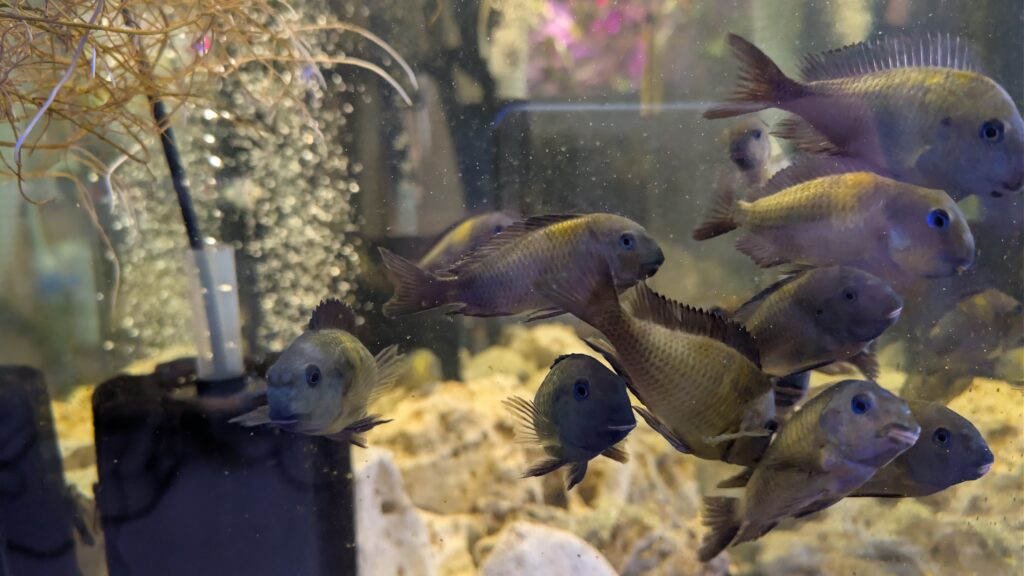
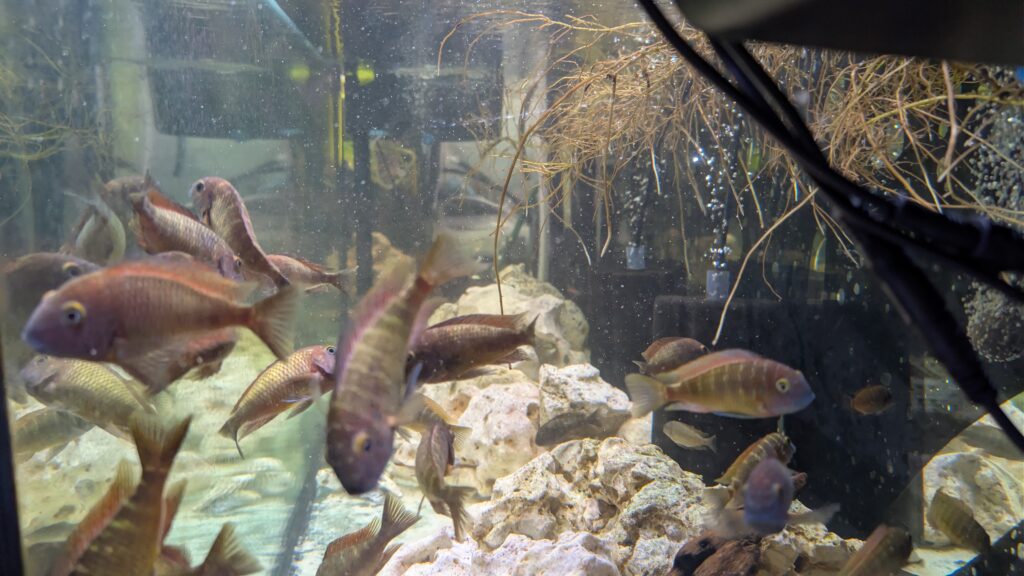
For Tropheus, an aquarium with a length of at least 150 cm and a volume of 250-400 liters is recommended. There should be fine sand at the bottom of the aquarium. To provide enough hiding places for the chased perch, place a considerable number of stones in the aquarium.
It is recommended to create at least one or several visual barriers in the aquarium with the help of stones. Water chemistry is also of paramount importance for Tropheus. The pH should be above 7.5 (from 7.5 to 9.5). The temperature should be constantly between
25 and 27°C. The temperature should never exceed 29°C as this could be fatal for Tropheus. Higher temperatures increase the need for oxygen, while at the same time reducing the oxygen content in the water. The water in the lake is very clean and rich in oxygen in the upper 40 m. Therefore, we also ensure that the oxygen content in the aquarium is high. This is ensured by air pumps, filter outlets directed to the water surface, or by means of current pumps directed to the water surface, which additionally help with the undulation of the water surface. Tropheus are also very sensitive to the presence of ammonia, nitrites and nitrates in the water, so it is important that the filter is sufficiently powerful and well biologically activated. Ammonia and nitrite cause immediate poisoning. Elevated nitrates, on the other hand, lead to a slow deterioration of health. Therefore, regular weekly 15 to 30% water changes are important (depending on stocking). The water that is changed should also be rich in oxygen.
Group size & stocking:
It is practically impossible to reproduce the natural environment of Tropheus in an aquarium, as this would require an enormously large aquarium. In nature, most adult Tropheus are territorial, and therefore in an aquarium one or a few territorial males take up their own space (territory), leaving room for the remaining males and females. Given that there is more food in an aquarium than in nature, the remaining non-territorial Tropheus have somehow calmed down the tendency for each to have their own territory for feeding. It is most advisable to house Tropheus in relatively large groups (from 15 to 25). In such a group, there does not necessarily have to be only one or two males (there can be more). However, there should be at least 3 to 4 females per male. However, in such a group, only one male will most likely be dominant and will own a certain space (territory) in the aquarium, and only this male will spawn. In principle, we can also have slightly smaller groups in a group aquarium. Suitable roommates in such a group aquarium are mainly other herbivorous Tanganyika groupers, such as smaller Petrochromis, Gobi groupers (Eretmodus, Tanganicodus and Spathodus) and groupers from the Simochromis species. We never house the same species of Tropheus from different geographical variants together in an aquarium (e.g. two species of T. moorii), because the possibility of crossbreeding is quite high. However, we can house different species of Tropheus together. It is best to choose those that also live together in the same locations in nature. For example, in principle, we can house T. duboisi with any other species of Tropheus, although this species can be a problem, because they are less aggressive than other species of Tropheus and it is therefore better to house them in a separate aquarium. When housing Tropheus, it is best to initially house a larger group of juveniles and thus determine their territories gradually as they grow up. When settling adult Tropheus, the “war” for territories can be very bloody. It is also very difficult to add any Tropheus to a group where territories have already been established.
Diet & feeding:
Herbivore. In the lake, Tropheus feed on filamentous algae from the aufwuchs. In the aquarium, some of this algae can grow on stones, but probably not enough for this to represent their majority diet. As an alternative, the best diet for Tropheus in the aquarium is leaves with a sufficiently high spirulina content. I personally use and would recommend 36% spirulina forte from ‘Tropical’ brand. We can also occasionally offer food such as Daphnia, Cyclops and Mysis. They also consume some of this food when scraping algae from the aufwuchs in the lake. However, we should strictly avoid high-protein food, as this can be fatal for Tropheus. They have a very long digestive tract, which is adapted to a diet with a low protein content. High-protein food can quickly lead to a disease known as bloat, to which they are very sensitive. Adult perch are fed only once a day, and only as much as they can eat in two minutes (during this time, they eat as much or even more than they would in the lake all day). In principle, they can be fed several times a day, but then this amount of food intended for one meal should be divided into portions accordingly.
Breeding behaviour:
They are typical mouthbrooders. Tropheus usually start spawning when they reach the age of 12 months (some can be much later). Spawning begins with the dominant male chasing the female. In a lake, mating begins with the female coming to the male’s territory and starting to feed there. However, since in an aquarium the male’s territory is usually the entire aquarium, the dominant male chases the females all the time (due to the presence of females in his territory) even if they are not yet sexually mature. Therefore, it is important to have enough hiding places and visual barriers in the aquarium so that the females can retreat if necessary. A sexually mature female usually responds to the male’s courtship (shaking) and follows him to his territory. Spawning usually occurs in the calmest part of the male’s territory, usually on a slightly sloping area. Before the female begins laying eggs, she leans to one side with her belly towards the male and begins to shake violently. When she lays one egg, she jerkily reaches out and picks it up in her mouth. During this time and also after the female already has the egg in her mouth, the male fertilizes it. This process is then repeated until all the eggs are fertilized. The eggs are relatively large (from 5 to 7 mm) so there are correspondingly fewer of them (around 6 to 16). The female carries the young for an average of 24-26 days. After this time, the female begins to slowly release the young. She usually guards them for a few more days after releasing them. The male plays no role in protecting the young and usually chases the female away from her territory immediately after spawning. Unlike most mouthbrooders (e.g. Malawi mbun), female Tropheus fish also feed while carrying the young. However, it has been found that females of some species accept food, but do not devour it (only the young feed on it). Meanwhile, in other species of Tropheus, it was discovered that females also feed normally with their young during the period of gestation.
Aggressiveness:
Unlike most Haplochromis in the lake, Tropheus also have their own territories (for feeding). However, the territories of males are usually 1x to 2x larger than the territories of females. In the aquarium, due to the above-mentioned reason (limited space), only a few or only one dominant male owns the territory. All other perch move out of this territory. However, they are very aggressive, especially within their own species, and do not show their aggression to other species in the aquarium as much. Due to this great intraspecific aggression, it is recommended to house them in larger groups so that the aggression is distributed among several individuals.
© 2024 All Rights Reserved.